Quick answer: A cleaning removes soot, creosote and debris. An inspection checks the condition of the chimney and tells you what work, if any, it needs. They are often done during the same visit but are not interchangeable. Cleaning does not prove a chimney is safe, and an inspection does not remove buildup.
Key takeaways
- Cleaning removes buildup. Inspection evaluates condition.
- Many homeowners book both, but a cleaning does not automatically include a full inspection.
- Industry guidance recommends inspecting chimneys at least once a year.
- There are three inspection levels. The right one depends on your situation.
- Always ask what a service includes before you book. Armstrong’s answers are below.
Which do you need?
| Your situation | What is usually recommended | Next step |
|---|---|---|
| Routine annual maintenance | Inspection, with cleaning if the inspection shows it is needed | Book inspection |
| Smoke, odors or visible damage | Inspection to find the cause | Book inspection |
| Buying or selling a home | A more detailed inspection (often Level 2) | Book Level 2 |
| Changing fuel or adding an appliance | A more detailed inspection (often Level 2) | Book Level 2 |
| After a suspected chimney fire, storm or malfunction | A more detailed inspection before you use the system again | Call us |
In every case, the inspection tells you what work is actually needed. That way you pay for what your chimney needs, not a standard package.
Still not sure? Call us and we will tell you. Tell us what your chimney does, when it was last done and what you burn. We will recommend the right service. Book an inspection or call (860) 854-1894.
Cleaning vs. inspection at a glance
| Chimney cleaning | Chimney inspection | |
|---|---|---|
| Purpose | Remove soot, creosote and debris | Evaluate condition and safety |
| Typical tasks | Brushing and sweeping the flue, smoke chamber and firebox; removing nests or debris | Checking the chimney, liner, cap, crown, damper and other parts; documenting findings |
| What you get | A cleaner chimney with less fire risk from buildup | A report of what was found and what work is recommended |
| Limitations | Does not confirm the chimney is free of cracks, leaks or damage | Does not remove buildup |
| Possible next steps | Inspection, repairs if problems are noticed | Cleaning, repairs, further inspection, or nothing at all |
Some technicians will note obvious problems they see while cleaning. But unless an inspection is part of the service, a cleaning visit should not be treated as a full safety check.
What does chimney cleaning involve?
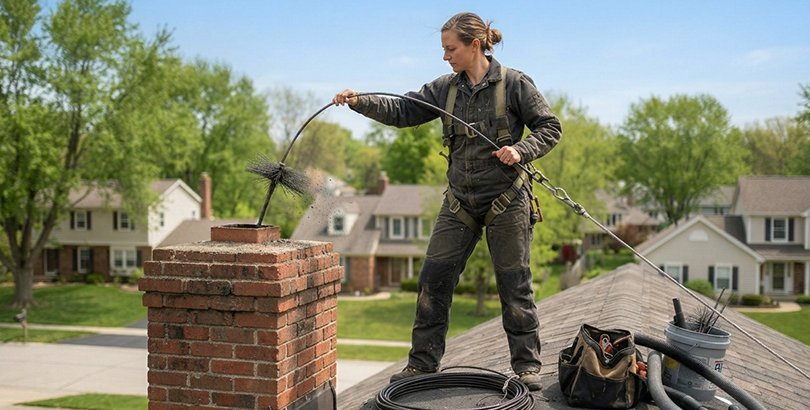
A cleaning, sometimes called a chimney sweep, removes the buildup that forms when you burn fuel. Depending on your system and what you agree on, it may include:
- Cleaning the flue with brushes and rods sized to the flue
- Cleaning the smoke chamber, smoke shelf and damper area
- Cleaning the firebox
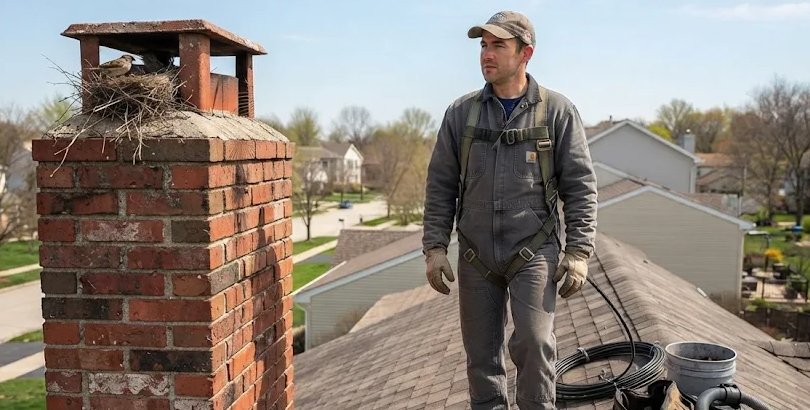
- Removing debris such as nests, leaves or fallen material
- Protecting your home with drop cloths and vacuums to contain soot and dust
What gets cleaned depends on the type of chimney and appliance. A wood stove, an insert and an open fireplace are each cleaned a bit differently.
What cleaning cannot tell you: whether the liner is cracked, whether the crown is leaking, whether the flashing is failing, or whether there are hidden problems inside. That is the job of an inspection. Learn more about our chimney cleaning service.
What does a chimney inspection involve?
An inspection looks at the condition of your chimney system. The technician checks the parts that are accessible within the agreed scope, which may include:
- The firebox, damper, smoke chamber and flue
- The chimney liner
- The cap, crown and exterior masonry
- The flashing and roof connection
- The connection to your fireplace or appliance
The technician then documents what they found, often with photos, and recommends next steps. Those might be cleaning, repairs, a more detailed inspection, or no work at all.
Every inspection has limits. A technician can only see what is accessible within the scope. If they suspect a problem in a hidden area, they may recommend a more detailed inspection. Learn more about our chimney inspection service.
Book the inspection that tells you what you need. Inspections start at $69 and basic chimney cleaning starts at $199, with 10% off for seniors and veterans. Book an inspection or call (860) 854-1894.
Understanding inspection levels
NFPA 211, the National Fire Protection Association’s chimney standard, describes three levels of inspection, each going further than the last. The Chimney Safety Institute of America (CSIA) uses these levels too.
Level 1. The readily accessible parts of the chimney, inside and outside, plus the accessible parts of the fireplace or appliance and its connection to the chimney. The technician checks that the chimney is structurally sound, free of blockages and free of excessive buildup. Used for routine annual checks when your system has not changed and you will keep using it the same way.
Level 2. Everything in Level 1, plus accessible areas such as attics, crawl spaces and basements, and a video scan or similar method to examine the inside of the flue and liner. Used when something about your system changes, such as switching fuel, replacing or adding an appliance, or relining. Also recommended when a home is sold or transferred, and after an event that may have caused damage, such as a chimney fire or severe storm. A camera scan is one part of a Level 2, not the whole thing.
Level 3. Everything in Levels 1 and 2, plus removing certain parts of the building or chimney to reach concealed areas. Used when a Level 1 or 2 points to a serious hidden problem that cannot be evaluated any other way. Not a routine inspection.
Industry guidance vs. legal requirements: NFPA 211 and CSIA guidance are industry standards. Local building codes, insurance requirements and real estate contracts may set their own rules. Check with your town, insurer or real estate professional if you are not sure what applies.
Buying, selling or changing your system? Ask for a Level 2. We will confirm which level you need before we start. Book an inspection or call (860) 854-1894.
What is included when you book with Armstrong
| Question | Armstrong’s answer |
|---|---|
| What exactly is included? | Every visit includes a full inspection of your chimney and fireplace or stove, plus a written summary of what we found. We check the firebox, damper, flue liner, smoke chamber, chimney crown, cap and visible masonry. We clean the system when the inspection shows it needs it. Repairs, relining, waterproofing and other corrective work are not part of the visit. We quote those separately. |
| Which inspection level, and why? | Level 1 is the right choice for a routine yearly check when nothing has changed. Level 2 is the right choice when something has changed: a new appliance or fuel type, a home sale, or after a chimney fire, storm or earthquake. It adds a camera scan of the flue and a check of the attic and crawl space areas around the chimney. If you’re not sure which one fits, tell us your situation and we’ll recommend one. |
| Is cleaning included, or quoted separately? | Cleaning is done when the inspection shows it’s needed, and we tell you before we start. If your chimney is clean and safe, you don’t pay for a cleaning you didn’t need. |
| Will I get photos or a written report? | Yes. You get photos of anything we find and a written summary of the condition of your chimney, in plain language. |
| What if you find something that needs more investigation? | We tell you what we found, what we recommend and why. Nothing extra is done until you’ve seen the quote in writing and said yes. If it needs a closer look, such as a camera scan, we explain what that involves first. |
How we explain findings and next steps. After your visit we keep three things separate so you always know where you stand: what we observed (with photos where possible), what we recommend and why, and what it would cost, as a written estimate. You are never asked to approve work without understanding what it is for.
What affects price?
- System type: Open fireplace, insert, wood stove or furnace flue
- Access: Roof pitch, chimney height and how easy it is to reach
- Buildup condition: Heavy or glazed creosote takes more time and different methods
- Inspection scope: A Level 2 or 3 involves more work than a Level 1
- Additional work: Repairs, debris removal or more than one flue
Request a quote: tell us what you have and what it is doing, and we will give you a clear quote.
Get a clear quote. Tell us your system type and what you need. Book an inspection or call (860) 854-1894.
Frequently asked questions
Does every inspection require cleaning?
No. If the inspection shows little buildup and no blockages, cleaning may not be needed. The inspection tells you. Book an inspection.
Does cleaning prove a chimney is safe?
No. Cleaning removes buildup, which lowers fire risk. It does not check for cracks, leaks, damaged liners or other hidden problems. Only an inspection can evaluate condition. Add an inspection to your cleaning.
Is a camera inspection always necessary?
No. Routine annual checks on an unchanged system usually do not need one. It is recommended when there are signs of a problem, when the system changes, after a chimney fire, or when a home is sold. Ask which level you need.
Should I book both together?
Many homeowners do. It is convenient and lets the technician see the flue clearly after cleaning. Book a combined visit.